The Volkswagen Kübelwagen (Type 82) remains a significant piece of automotive and military history. Its development and deployment during World War II highlight the ingenuity and adaptability of early Volkswagen engineering. The Kübelwagen’s legacy continues to inspire modern vehicle designs, bridging the past with the present.
Overview
The Volkswagen Kübelwagen (Type 82) stands as a notable vehicle from World War II, used extensively by the German Wehrmacht and Waffen-SS. Developed from the early Volkswagen Beetle designs, approximately 55,000 units were manufactured at the Volkswagen plant in KdF-Stadt, now known as Wolfsburg. Although it performed similarly to the Allied jeep, its rear-wheel drive limited its effectiveness on rough terrain compared to the four-wheel-drive jeep.
Technical Specifications
- Length: 3.74 m
- Width: 1.6 m
- Height: 1.65 m / 1.11 m
- Empty Weight: 750 kg
- Combat Weight: 1150 kg
- Armor: None
- Engine: Air-cooled 4-cylinder boxer engine
- Displacement: 985 cc / 1131 cc
- Gears: 4 forward, 1 reverse
- Maximum Speed: 80 km/h
- Range: 400-450 km
Development History
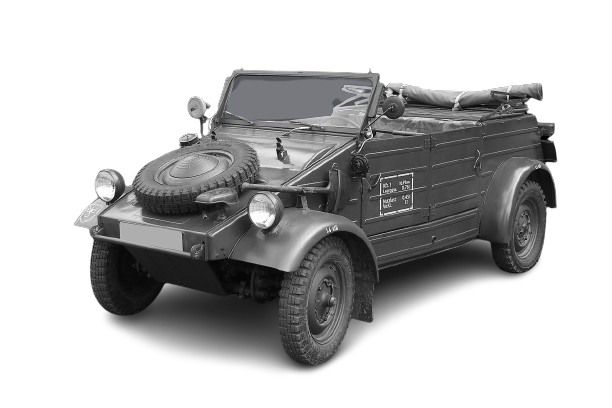
In 1934, the Kraft durch Freude (KdF) car project, which later became the Volkswagen Beetle, included military specifications. Early prototypes, like the three-seater from 1937, were designed to carry soldiers and equipment. The KdF-Wagen’s limitations as an off-road vehicle led Ferdinand Porsche to develop the Porsche Type 62, featuring a distinctive rectangular steel body by Erwin Komenda, and equipped with four doors, including front suicide doors. This distinct body shape also led to its name: Kübelwagen is a shorter form of Kübelsitzwagen, meaning ‘bucket-seat car’.
By 1938-1939, prototypes were tested, including during the 1939 invasion of Poland, which revealed critical flaws such as low ground clearance and inadequate speed control. These issues were addressed in the improved Type 82 model, featuring enhanced drivetrain and suspension. Eventually, the Kübelwagen Typ82 became a valid alternative to the Wehrmacht-Gespanne (Zündapp KS 750 en BMW R75), both motorcycles.
Production and Variants
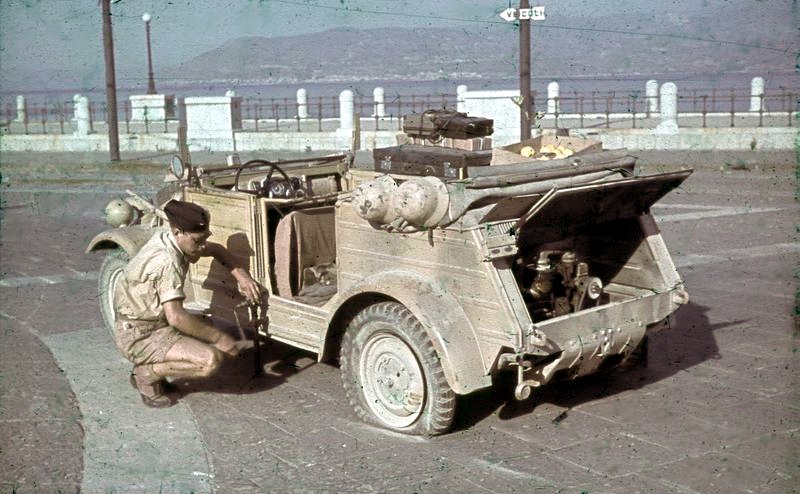
Production of the Kübelwagen began in February 1940 at KdF-Stadt. The steel bodies were manufactured by Ambi-Budd in Berlin and shipped to the main plant. By December 1940, the 1,000th unit was completed. In total, around 55,000 units were built, deployed across Europe and North Africa. Over time, the engine capacity was increased from 985 cc to 1131 cc, and several special versions were produced:
- Type 155: A half-track version for the Eastern Front.
- Type 230-239: A variant powered by a gas generator using wood: ‘Holzbrenner’.
- Type 332: A variant powered by a gas generator using anthracita
- Type 330: A variant powered by a gas generator using coal
- Type 240: A variant powered by a generator using a gas bottle
Production ceased as Soviet forces advanced on Berlin, disrupting the supply chain.
Ferdinand Porsche also developed the Type 86, a four-wheel-drive version of the prototype, and the Type 87, a four-wheel-drive production model. Only a handful of these were built before the project shifted to focus on the Schwimmwagen, an amphibious vehicle.
In the 1970s, Volkswagen revisited the Kübelwagen concept with the Type 181, also known in North America as the “Thing,” which became popular for its rugged design and versatility.